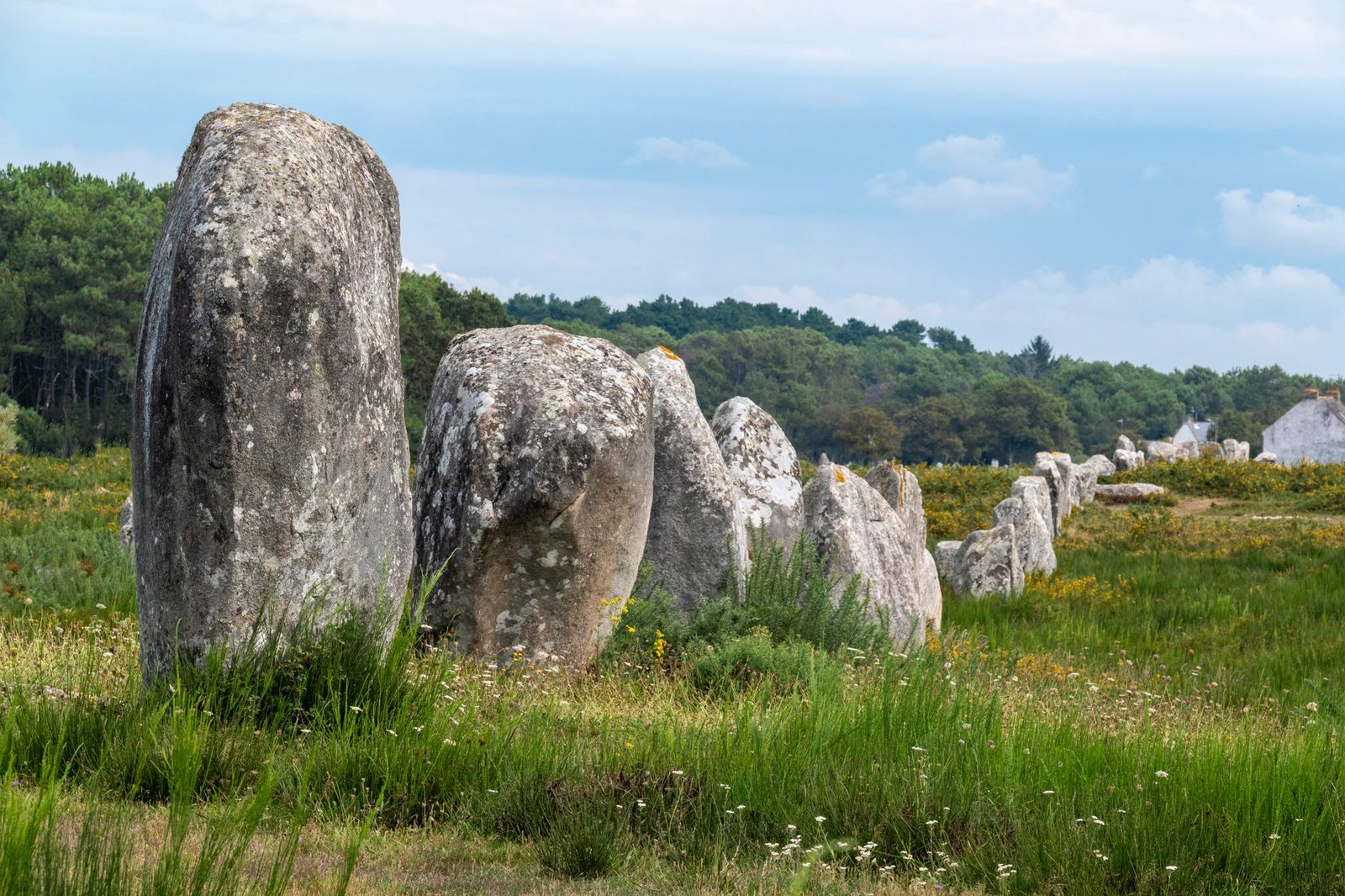
Stretched across the fields of southern Brittany, in France, more than 3,000 standing stones march in long, dead-straight rows toward the horizon. Some are barely knee-high; others tower taller than a person. They were raised before Stonehenge, before the first Egyptian pyramid, by farmers who left no writing at all. And after two centuries of study, the honest answer to why were the Carnac stones built is still: we don’t fully know. That uncertainty is exactly what makes the site so magnetic.
The Largest Megalithic Site on Earth
The Carnac alignments are not a single monument but a cluster of them, spread over roughly four kilometres near the town of Carnac. The three great rows — Le Ménec, Kermario, and Kerlescan — together contain over 3,000 upright stones called menhirs (from the Breton men, stone, and hir, long).
The stones are arranged in parallel lines that fan slightly, often beginning with the tallest menhirs and tapering to smaller ones. At the ends of some rows sit cromlechs, semicircular or egg-shaped enclosures of stones. Nothing else in Europe comes close to this scale. Whoever organised the work moved thousands of blocks of local granite, some weighing many tonnes, using only wooden levers, ropes, and sheer human muscle.
Older Than the Pyramids
Radiocarbon dates from nearby tombs and pottery place the main phase of building between roughly 4500 and 3300 BCE — deep in the Neolithic, the age of Europe’s first farmers. That makes Carnac older than Stonehenge’s iconic circle and older than Egypt’s earliest pyramids.
This matters because it overturns a lazy assumption: that monumental architecture required kings, cities, and armies of slaves. The people of Neolithic Brittany lived in small farming communities. Yet they coordinated a construction project that unfolded across centuries and possibly dozens of generations. Like the builders of Göbekli Tepe, they show that the urge to raise something vast and lasting came long before the first empires.
Why Were the Carnac Stones Built?
Here the theories multiply. No single explanation satisfies everyone, which is precisely why the question endures.
- A sacred landscape. Many archaeologists see the rows as ceremonial routes — processional avenues that channelled the movement of the living, perhaps between the world of the fields and the world of the dead. The stones cluster near burial mounds, hinting at a link to ancestors.
- An astronomical instrument. In the 1970s, engineer Alexander Thom surveyed the alignments and argued they were built to track the movements of the sun and moon, with sightlines marking solstices and lunar extremes. Some stones do appear to point toward significant risings and settings.
- Territorial markers. The rows may have declared ownership or identity, a monumental way of saying this land belongs to our people.
- A commemoration of the dead. The sheer repetition of stones has led some to suspect each menhir memorialised a person or event, an idea impossible to prove.
The truth is that a monument used for 1,000 years probably meant different things to different generations. Its purpose almost certainly evolved.
The Broken Giant of Locmariaquer
A short distance from the rows lies one of prehistory’s most staggering objects: the Grand Menhir Brisé, or Great Broken Menhir, at Locmariaquer. It now lies in four fractured pieces, but reassembled it would have stood around 20 metres (65 feet) tall and weighed an estimated 300 tonnes — the largest single stone ever raised by Neolithic Europeans.
How it was quarried, transported, and lifted upright is still debated, and how it fell is equally unclear. Some researchers suspect an earthquake toppled it; others think it was deliberately pulled down. Its granite may not even be local, implying it was hauled a considerable distance. Standing beside its shattered fragments, it is impossible not to feel the ambition of a people we still barely understand.
Legends, Saints, and Petrified Soldiers
Where evidence runs out, folklore rushes in. The most famous Breton legend claims the stones are a Roman legion turned to rock. As the story goes, the pursued Saint Cornély (Cornelius) fled to the coast and, cornered by soldiers, transformed the entire army into pillars of stone — which is why the rows still stand like ranks of frozen troops. The town’s church is dedicated to the same saint.
Other tales speak of fairies or giants who set the stones in place. These myths are not history, but they preserve something real: for thousands of years, people who had forgotten the builders still sensed that the alignments were extraordinary, and reached for the supernatural to explain them. The same instinct surrounds monuments like Newgrange in Ireland, where later generations wove myth around an astronomy they could no longer read.
Standing Among the Stones
Walk the rows at dawn and the mystery becomes physical. The stones cast long shadows, the lines converge and vanish, and you feel the presence of people who thought this was worth a millennium of labour — yet left no explanation. Was it a temple, a calendar, a map of the heavens, a memorial to the dead, or all of these at once? The Carnac alignments guard their secret well.
If you want to see these silent granite armies up close, trace the theories from Alexander Thom’s astronomy to the latest excavations, and stand beside the fallen giant of Locmariaquer, the full visual story is waiting on our Mysteries of History YouTube channel. Watch it there and decide for yourself why the Carnac stones were built.
Enjoyed this? More videos on the Mysteries of History YouTube channel.