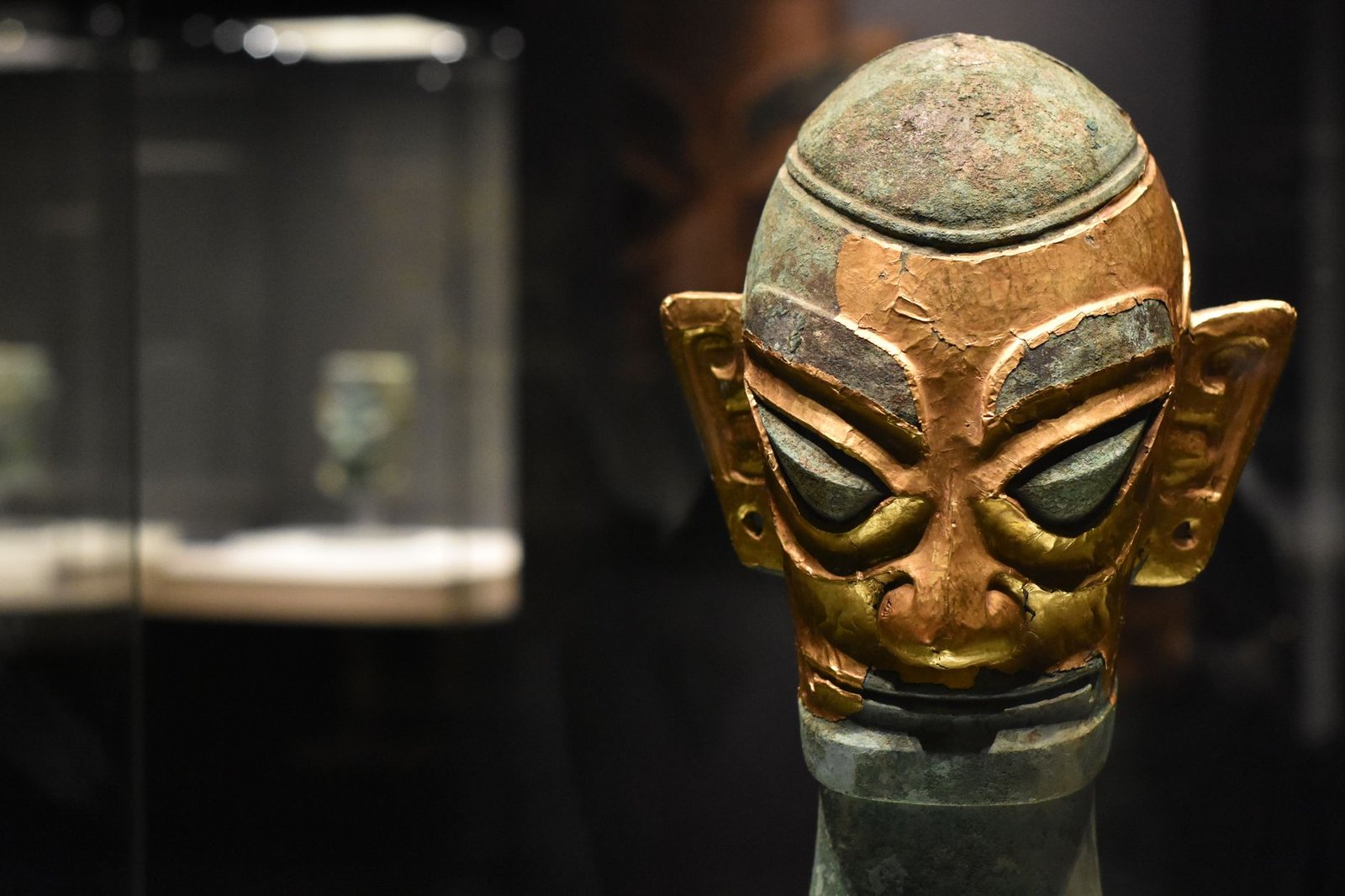
In 1986, two brick workers digging clay near the village of Sanxingdui in China’s Sichuan province struck something hard. What they uncovered would force historians to rewrite the story of early Chinese civilization: pits crammed with bronze masks so strange they look almost otherworldly — faces with blade-like eyebrows, slit mouths, and eyes that bulge outward on stalks. They belonged to a culture no ancient text had ever named. So who built the Sanxingdui bronze masks, and why did they smash and bury their finest treasures? The answer is one of archaeology’s most haunting open questions.
A Lost Kingdom Hiding in Plain Sight
For most of the twentieth century, the conventional view held that Chinese civilization radiated outward from a single cradle along the Yellow River, home of the Shang dynasty. The discovery at Sanxingdui shattered that tidy picture. Roughly 1,500 kilometers to the southwest, in the fertile Sichuan basin, a sophisticated Bronze Age society had flourished between about 1600 and 1100 BCE — contemporary with the Shang, yet artistically unlike anything else in the ancient world.
Scholars now connect Sanxingdui to the legendary kingdom of Shu, a state mentioned only in fragmentary later legends and long dismissed as myth. The site itself was a walled city covering several square kilometers, with rammed-earth ramparts, residential zones and workshops. This was no isolated village. It was the capital of a powerful, organized culture that had simply vanished from historical memory — its very existence unrecorded in the writings of its neighbors.
The Masks That Should Not Exist
The bronzes are what make Sanxingdui unforgettable. Among them stands a gold-foil-covered human head, life-sized statues, and dozens of masks ranging from human-scale to monstrous. The most famous piece is a colossal mask nearly 1.4 meters wide, its cylindrical pupils projecting some 16 centimeters from the face like telescopes.
Why the protruding eyes? One popular interpretation links them to Cancong, the semi-mythical first king of Shu, who legend says had bulging eyes. The exaggerated features may represent deified ancestors or gods rather than ordinary people. Other finds defy easy explanation entirely: a 2.6-meter-tall bronze figure standing on an elaborate pedestal, and a magnificent bronze “sacred tree” nearly four meters high, hung with birds and what appear to be fruit — possibly a cosmic ladder linking earth and heaven.
The craftsmanship demanded advanced metallurgy, abundant resources, and a centralized authority capable of commissioning monumental religious art. Whoever built these objects possessed wealth, ritual sophistication, and a visual language all their own.
Why Were the Treasures Smashed and Buried?
Here the mystery deepens. The masks and statues were not found in tombs or temples but stuffed into sacrificial pits, many deliberately broken, burned, or bent before burial. Elephant tusks, jade blades, cowrie shells and charred animal bones were layered in alongside the bronzes. This was an act of destruction as much as devotion.
Archaeologists have proposed several explanations. One theory holds that the pits represent a grand religious sacrifice, with precious objects ritually “killed” and offered to the gods or ancestors — a practice echoed in other ancient cultures that destroyed valuables to consecrate them. Another suggests the burials followed a political upheaval: a change of dynasty, a defeated faction’s regalia disposed of, or the abandonment of the city after a flood or war. Some researchers point to evidence that the Sanxingdui people relocated downstream to a later site at Jinsha, suggesting the burials marked the end of one chapter and the start of another.
Whatever the motive, the people who created these masterpieces chose to bury them with intent — a decision as deliberate as the puzzling abandonments seen at other ancient sites, like the questions surrounding why the city of Cahokia was abandoned.
New Pits, New Questions
For decades the two original pits were all archaeologists had. Then, between 2019 and 2022, excavators uncovered six more sacrificial pits, yielding thousands of additional artifacts — including a stunning bronze altar, a turtle-shaped box, and a delicate figure with the body of a serpent and human hands. Advanced techniques like climate-controlled excavation chambers, 3D scanning and protein analysis are now being applied to fragments of silk, the earliest yet found in southwestern China.
These discoveries confirm that Sanxingdui was even richer and stranger than first thought. They also sharpen the central enigma: this culture left no decipherable writing. Unlike the Shang, who inscribed oracle bones with thousands of characters, the people of Shu remain mute. We can hold their gods in our hands, yet we cannot read a single word they wrote — assuming they wrote at all.
Outsiders, or Purely Homegrown Genius?
The alien appearance of the masks has inevitably spawned fringe speculation, including claims of extraterrestrial influence. The evidence points firmly to a human, local origin. Bronze technology, jade-working and ritual concepts show clear links with the broader Bronze Age world of central China, suggesting Sanxingdui was part of a wider network of exchange rather than an isolated anomaly.
Yet the artistic vision is unmistakably its own. The Shu artisans absorbed techniques from their neighbors and transformed them into something radically new — proof that early China was not a single monolithic story but a tapestry of distinct, interacting cultures. Sanxingdui reminds us how much of the human past has been erased simply because the victors wrote the histories. Like the undeciphered Voynich Manuscript, it confronts us with a civilization that speaks in images we can admire but not yet fully understand.
See the Masks Come to Life
The bronze faces of Sanxingdui are best appreciated in motion — the sheer scale of the sacred tree, the eerie glint of the gold mask, the freshly excavated pits still giving up their secrets. We’ve brought the full story to life on the Mysteries of History YouTube channel, with stunning visuals of the artifacts and a deep dive into the theories of who built them and why they were buried. If this lost kingdom has captured your imagination, watch the complete episode and join the conversation about one of the ancient world’s greatest unsolved puzzles.
Enjoyed this? More videos on the Mysteries of History YouTube channel.